Why DACs Matter More Than You Think: The Audio Science Behind Every Pioneer CDJ-3000 in Miami
You've spent hours curating your sets. You've obsessed over EQ curves, compression ratios, and track selection. But there's a component sitting quietly inside every piece of gear you touch — one that shapes every single sound you send to the speakers — that most DJs never think about. It's called a digital-to-analog converter, or DAC, and understanding it might be the most overlooked technical leap a serious DJ can make.
This isn't theory for its own sake. This is the science behind why the same track sounds radically different on a Pioneer CDJ-3000 versus a budget media player — and why the room, the gear, and the signal chain you practice on fundamentally shapes your ear over time.
What a DAC Actually Does
Every digital audio file — your FLACs, your 320kbps MP3s, your WAVs — exists as a stream of binary data: zeros and ones. A DAC's sole job is to translate that digital information into a continuous analog electrical signal that your mixer, amplifier, and speakers can actually use to move air.
The quality of that translation is everything. A poor DAC introduces jitter (timing errors in the conversion process), noise floor elevation, and harmonic distortion. These artifacts are subtle — you might not consciously identify them — but they accumulate across a signal chain and arrive at your ears as a kind of listening fatigue, a vagueness in the low end, or a harshness in the highs that you can't quite name.
A high-quality DAC does the opposite. It preserves transient detail, delivers a low noise floor, and renders stereo imaging with precision. The difference between a mediocre and an exceptional DAC isn't just audiophile mythology — it's the gap between a mix that translates and one that doesn't.
How the CDJ-3000 Raises the Standard
Pioneer DJ made a deliberate engineering statement with the CDJ-3000's internal DAC. The flagship media player uses a high-grade 32-bit DAC implementation paired with a redesigned audio circuit — a significant departure from previous CDJ generations. The result is a measurably wider dynamic range, lower total harmonic distortion (THD), and a high-frequency response that extends cleanly to 20kHz without rolloff artifacts.
In practice, this means that when Peggy Gou drops a warm analog bassline or HAAi layers dense harmonic textures, the CDJ-3000 renders those elements with dimensional clarity. You hear space in the mix. You hear air around the transients. The low end is tight, not boomy. These aren't marketing claims — they're the audible consequence of precision digital-to-analog conversion.
For DJs who want to develop a genuine ear for mix quality, regularly practicing on CDJ-3000s isn't a luxury — it's a calibration tool. Your ears learn what good audio feels like, and that standard becomes the reference point you carry into every set.
The DJM-V10 Signal Chain: Where Your DAC's Work Gets Protected or Destroyed
Here's where it gets interesting. Even a world-class DAC can be undermined by what comes next in the signal chain. The Pioneer DJM-V10 mixer was engineered specifically to be a worthy partner for the CDJ-3000's audio quality — featuring 96kHz internal processing, a 32-bit audio engine, and circuitry designed to preserve rather than color the incoming signal.
Many club mixers compress dynamic range or add their own sonic character (not always desirably). The DJM-V10 is built around the philosophy of transparency: what goes in should come out faithfully, with the DJ's EQ and filter decisions being the only deliberate alterations. The six-channel layout and dedicated isolator EQ on each channel give you surgical control without sacrificing the integrity of the source audio your CDJ-3000's DAC worked hard to produce.
This CDJ-3000 + DJM-V10 pairing is a closed-loop system of high-fidelity intent. Every component in the chain is designed to respect the one before it.
Why Your Practice Environment Shapes Your Ears
Here's the uncomfortable truth most DJ tutorials won't tell you: if you practice exclusively on consumer-grade gear or laptop outputs, you're training your ears to a flawed reference. You're developing muscle memory — and ear memory — calibrated to a substandard baseline.
When you then perform on professional gear in a serious club environment, you're not just learning new software or navigating an unfamiliar layout. You're hearing your music in honest, high-resolution detail for perhaps the first time. That dissonance is costly in a live set.
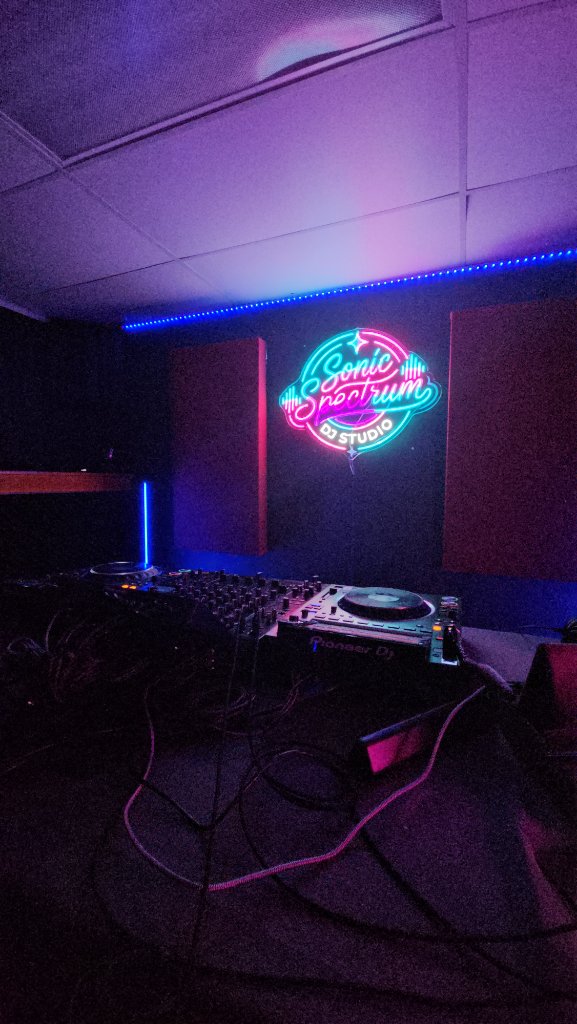
This is why practicing at a professional Miami DJ studio — with proper gear, professional monitors, and a treated acoustic environment — isn't about status. It's about training with the right reference. Booking studio time at Sonic Spectrum, where the standard rig is a CDJ-3000 and DJM-V10 setup in a purpose-built room, means your ears are developing against the same standard you'll encounter at any serious venue in Miami, Fort Lauderdale, or beyond.
The Actionable Takeaway
Start listening analytically. When you're in the booth, close your eyes during a transition and isolate the low end. Is the kick punchy or muddy? Is the sub sitting under the mix or pushing through it chaotically? Does the high-end shimmer or does it grate? These distinctions are only audible when your DAC and signal chain are honest enough to show them to you.
Read your gear's spec sheets. Look for DAC bit depth (24-bit minimum for professional work, 32-bit for flagship gear), THD ratings below 0.005%, and a signal-to-noise ratio above 110dB. These numbers have real-world consequences for your sound.
And then go play. Repeatedly. On gear that tells you the truth. Because the DJ who understands their signal chain — from binary data to analog waveform to speaker cone — is the DJ who makes decisions with intention, not guesswork. In a city with Miami's sonic standards, that precision is what separates a memorable set from a forgettable one.
 FOLLOW US