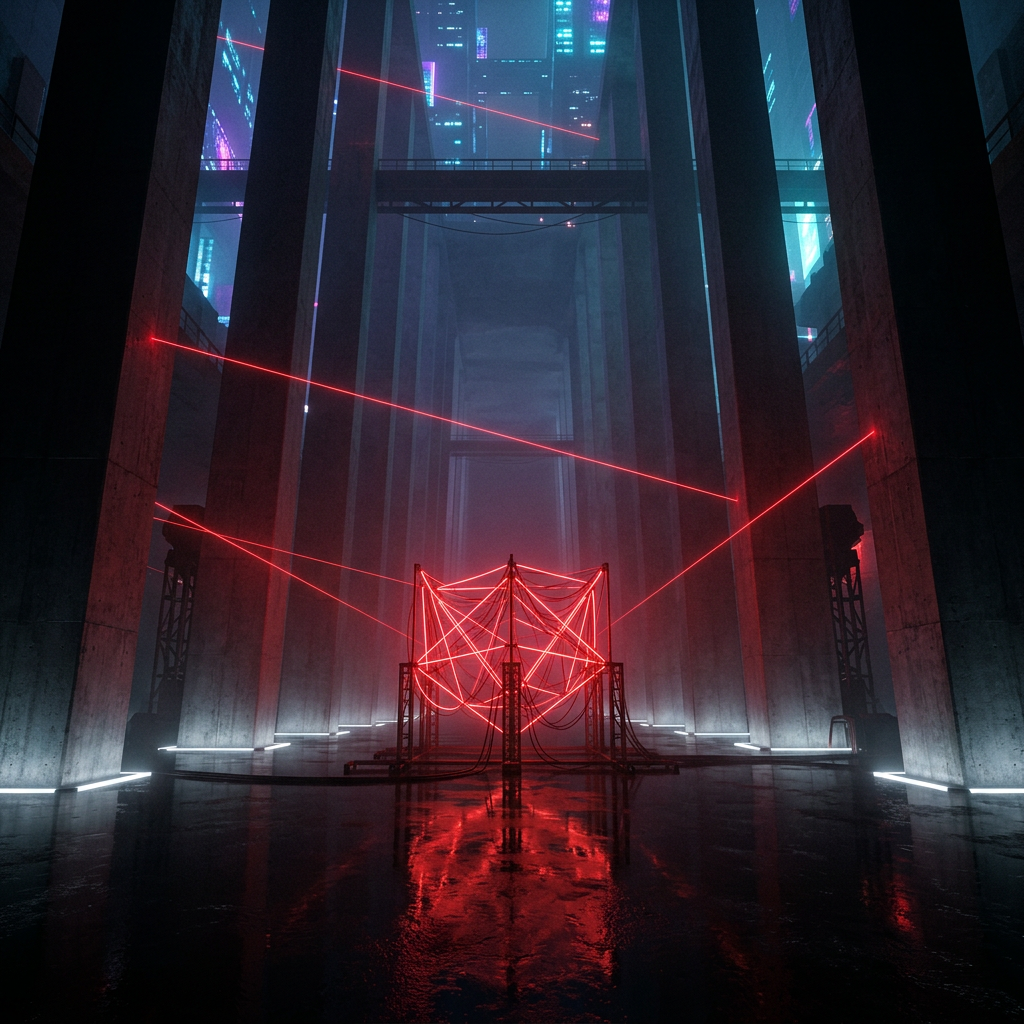
Plastikman and the Architecture of the Void
A Sonic Spectrum Editorial — For the Heads Who Listen Between the Beats
Who Is Plastikman?
There are artists who make music for the dance floor, and then there are artists who redesign the dance floor entirely — who walk into the room, remove everything that isn't essential, and challenge you to feel the space that remains. Richie Hawtin, operating under the alias Plastikman, belongs to that second, far rarer category.
Born in Banbury, England, and raised in Windsor, Ontario, Hawtin came of age in the shadow of Detroit — close enough to absorb its machine soul, far enough to mutate it into something alien and his own. Since the early 1990s, the Plastikman project has functioned less like a DJ alias and more like a philosophical statement: that techno doesn't need to be loud, dense, or aggressive to be devastating. That a kick drum, a hiss, and a carefully placed silence can hollow you out more completely than any wall of noise.
Hawtin's sonic DNA is built on negative space. Where most producers add, he subtracts. Where most DJs escalate, he decelerates — deepening the groove through repetition rather than resolution, holding tension until the room is breathing in unison. To understand Plastikman is to understand that restraint is a form of power, and that the most radical thing you can do in a club is slow down.
The Sound: Minimal, Microhouse & Hypnotic Techno Explained
The terms minimal techno, microhouse, and hypnotic techno get thrown around loosely, but they describe meaningfully different relationships with the dance floor.
Minimal techno, at its core, is a philosophy of reduction. Fewer elements, more space. The genre emerged in direct reaction to the maximalism of late-90s trance and big-room techno — producers like Hawtin, Robert Hood, and Basic Channel stripped the architecture down to its load-bearing walls. A four-four kick, a stripped-back hi-hat pattern, a bass frequency that moves more than it announces itself. The groove is molecular, felt in the chest before it's heard in the ears.
Microhouse — pioneered largely on labels like Perlon and Playhouse — took that minimalism and infected it with micro-rhythmic complexity. Clicks, glitches, field recordings, and off-grid percussion replaced traditional house elements. Ricardo Villalobos and Reinhard Voigt were architects of this space, but Hawtin's work orbited it closely, especially in the mid-2000s when his Minus label became a nexus for European and North American minimal crossover.
Hypnotic techno is perhaps the most experiential of these sub-genres. It isn't defined by BPM or structure so much as by effect. The goal is trance induction — repetition deployed with such precision and patience that the listener's critical mind disengages, surrenders to the pulse. Think Robert Hood's Minimal Nation, think early Underground Resistance, think the first two Plastikman albums. The hypnotic approach demands a different kind of listening: not analysis, but immersion.
Plastikman sits at the intersection of all three. His records are minimal in construction, microhouse in their textural obsession, and hypnotic in their psychological intent. He is, in the truest sense, a genre unto himself.
Origins & Influences
Hawtin's origin story is inseparable from Detroit. Growing up a short drive from the Motor City, he absorbed the first and second waves of Detroit techno — Juan Atkins' cybernetic futurism, Derrick May's emotional machine music, Kevin Saunderson's floor-wrecking pulse. But it was Model 500 and the industrial textures of early Wax Trax! releases that planted the seed of what would become Plastikman's aesthetic: techno as architecture, not spectacle.
In 1990, Hawtin co-founded Plus 8 Records with John Acquavella, releasing his own early work under aliases like FUSE — harder, more direct, Detroit-influenced techno that proved he could build a floor. But by 1993, the Plastikman alias arrived with a different mandate. The debut album Sheet One (NovaMute, 1993) landed like a transmission from another frequency entirely — spacious, acid-laced, and genuinely strange.
His influences expanded through the decade: the dub-informed space of Basic Channel, the cold industrialism of Throbbing Gristle, and the academic rigor of musique concrète all found their way into the Plastikman palette. When he launched Minus in 1998, it became the institutional home for a new wave of minimal techno — a label that shaped the sound of clubs from Berlin to Buenos Aires for the better part of a decade.
Key Records & Essential Listening
1. Sheet One — Plastikman (NovaMute, 1993) The founding document. Tracks like Spastik and Gak introduced a style of acid techno so stripped and warped it felt genuinely alien. Sheet One didn't arrive — it materialized.
2. Musik — Plastikman (NovaMute, 1994) Darker, slower, and more claustrophobic than its predecessor. Musik pushed the concept further: longer tracks, deeper repetition cycles, more deliberate use of silence. A masterclass in psychological pressure.
3. Consumed — Plastikman (NovaMute, 1998) The apex of Hawtin's reductive vision. Beats become suggestions. Bass becomes atmosphere. Consumed is less a dance album than an endurance meditation — and in the right room, at the right volume, it is completely transcendent.
4. Closer — Plastikman (Minus, 2003) A comeback record that arrived during the peak of minimal techno's global moment. Closer is more accessible but no less focused — proof that Hawtin could work within a commercial moment without surrendering his identity.
5. EX — Plastikman (Minus, 2014) Recorded live and released in conjunction with a multimedia AV performance, EX represents Hawtin's most conceptually ambitious Plastikman statement. It sounds like a machine dreaming.
The DJ Craft: How He Plays
Watching Richie Hawtin play a set is a lesson in architecture over explosion. He doesn't bring you to the peak — he builds the room, brick by brick, until the room is the peak.
His mixing style is surgical. Using his own M_nus hardware setups and later the Traktor-based systems he helped develop with Native Instruments, Hawtin performs as much as he mixes — layering stems, isolating frequencies, dropping individual elements in and out with the precision of a surgeon removing sutures. His sets reward patience: the first hour is often a slow pressure build, nearly ambient in its restraint, conditioning the floor for what comes later.
What DJs can learn from Hawtin: silence is a mix tool. Dropping the kick for four bars at the right moment creates more energy than adding a new element. His use of loop length variation — extending or truncating phrases by a beat or two — keeps the ear uncertain, leaning forward, searching for resolution that never quite arrives on schedule. It's DJing as controlled disorientation.
His energy arcs don't peak so much as plateau — he brings the room to a sustained elevation and holds it there, which is physically and emotionally more demanding on the dancer than a traditional build-drop structure. To hold a floor at that altitude for four, five, six hours requires absolute trust between DJ and room.
Why This Sound Matters to Your Development as a DJ
For DJs at any level, Plastikman is a curriculum in the fundamentals you can't see.
Modern DJ culture is obsessed with the drop, the ID, the reaction clip. But the craft lives in the negative spaces — in how long you hold a groove before evolving it, in how you use silence to reset the room's nervous system, in how you let a bass line breathe rather than suffocate it with layers. Hawtin's approach makes all of that visible, or rather, audible.
Studying his sets teaches patience — the hardest skill in DJing to develop and the most powerful to possess. It teaches listening: not just to the music, but to the floor, to the architecture, to the silence between elements. And it teaches trust in the groove — the understanding that repetition, when deployed with intention, is not laziness but hypnosis.
These are principles that translate across every genre. You don't have to play minimal techno to benefit from Hawtin's lessons. But you do need proper gear to practice them — a setup that lets you hear nuance, manipulate frequencies, and feel the difference between a mix that serves the groove and one that interrupts it.
How to Start Digging: Entry Points for New Listeners
- Start with: Consumed (1998) — the most complete Plastikman statement, and one of the greatest electronic albums ever recorded.
- Label exploration: Minus (minus.com) for Hawtin's own releases and his extended family of artists including Magda, Troy Pierce, and Gaiser.
- Broader minimal context: Perlon (Frankfurt) and Kompakt (Cologne) for microhouse and minimal house; M_nus, Ostgut Ton, and Drumcode for the techno spectrum.
- Essential mixes: Hawtin's 2001 Fabric mix (Fabric 04) remains a definitive minimal techno document — hour one in particular is a blueprint for restrained, intelligent floor building.
- Live experience: Search YouTube for his ENTER. Space Ibiza sets from 2012-2015. The residency was a weekly laboratory for everything discussed here.
- RA context: Resident Advisor's Hawtin archive includes several landmark podcast mixes and a career-spanning interview that remains one of the most technically detailed DJ conversations in print.
Sonic Spectrum is a Miami-based DJ studio committed to deep listening, serious craft, and the underground traditions that shape the floors we love. Follow us for more editorial spotlights on the artists and sounds that matter.
 FOLLOW US