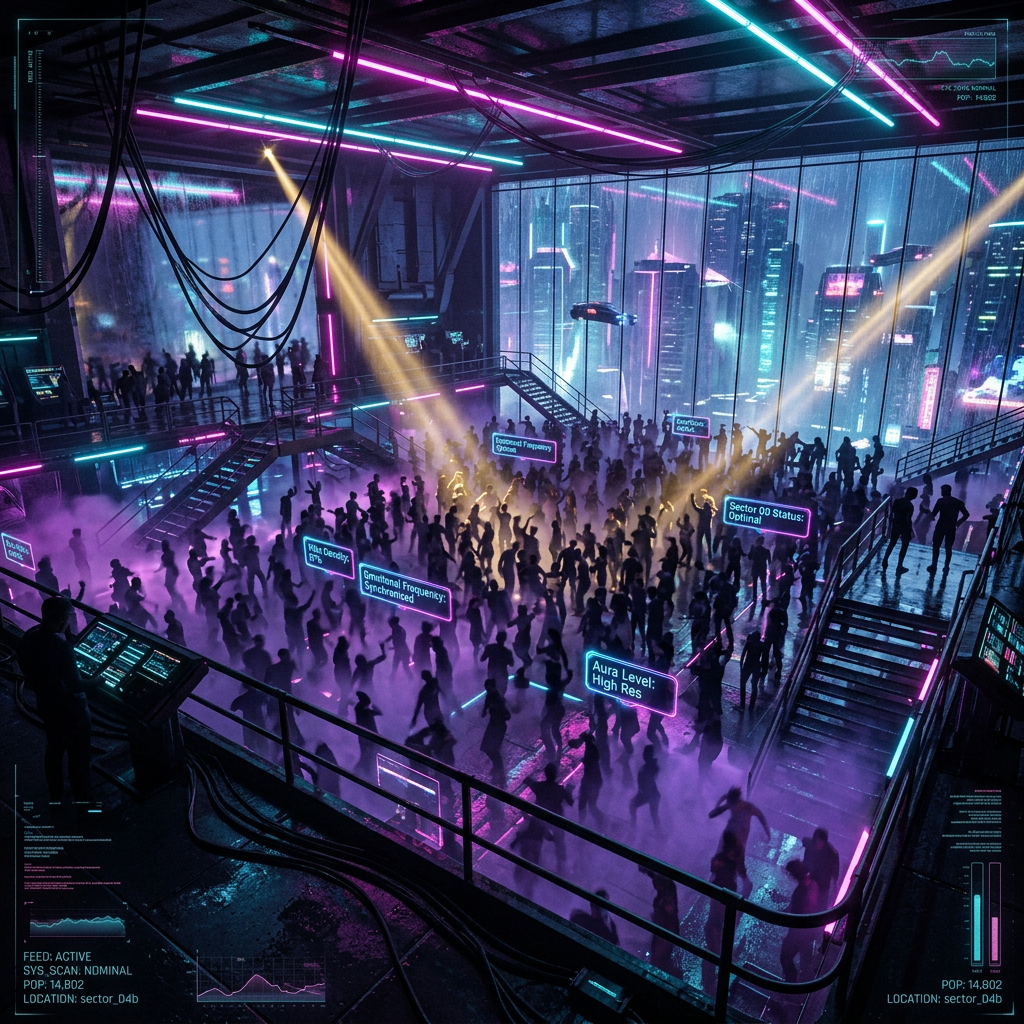
How to Read a Crowd and Adapt Your Tracklist in Real-Time (A Miami DJ's Guide)
The tracklist you planned at home is a hypothesis. The crowd is the experiment.
Every serious DJ knows the feeling: you've curated a meticulous set — BPM-mapped, key-matched, emotionally sequenced — and within four minutes on the floor, you realize the room has a completely different agenda. The question isn't whether this will happen. It's whether you're skilled enough to pivot before you lose the room entirely.
Crowd-reading is the most undervalued technical skill in DJing. It isn't instinct. It isn't luck. It's a discipline — one built through repetition, self-awareness, and deliberate practice. Here's how to develop it.
Understand What the Crowd Is Actually Telling You
Before you can respond to a crowd, you need to learn their language. People communicate energy through motion, density, and attention — none of which involves words.
Watch the floor, not the booth. Are people moving toward the dance floor or drifting toward the bar? Are conversations getting louder (a sign the music has lost them) or are heads nodding, eyes closing, bodies locking in? The difference between a room that's tolerating your set and one that's surrendering to it is visible if you know where to look.
Track your peaks and valleys. Every room has a natural energy arc. A Tuesday residency crowd at a Brickell lounge responds differently than a Saturday night at a warehouse in Wynwood. Before you even load your first track, read the room's baseline — the age demographic, the attire, the way people are ordering drinks. These are pre-musical cues that should already be reshaping your mental tracklist.
Trust the 2-minute rule. If a track isn't connecting within two minutes, it won't. Don't ride it out hoping for a turn. Start your exit strategy immediately — find a bridge track that lets you transition gracefully while you recalibrate.
2. Build a Modular Tracklist, Not a Linear One
The DJs who struggle to adapt in real-time are usually the ones who built their set as a fixed sequence. The DJs who thrive — think Fisher, Honey Dijon, or Dixon at peak Panorama Bar form — think in zones, not tracks.
Organize your library into emotional buckets: builders, peak-time weapons, comedown tools, crowd-pleasers, wildcards. On the Pioneer CDJ-3000, your playlist organization is everything. Use hot cues and memory cues not just for drop timing, but as escape hatches — jump points that let you pivot a track's direction mid-mix if the energy demands it.
The CDJ-3000's waveform zoom and track overview give you a surgical view of what's coming. A DJ who uses that display intelligently isn't just mixing — they're navigating. Learn to read a track's energy potential before it even starts playing.
3. Use Your Mixer as a Mood Instrument
The DJM-V10's four-band EQ is not a correction tool. It's a crowd-reading response tool.
When energy dips, resist the instinct to immediately drop a heavier record. Instead, use the low-EQ cut technique to strip the sub-bass, creating a moment of tension — then bring it back with a filter sweep on Channel 2 as your next track breathes in. The crowd feels the contrast as a release, not a reset.
The DJM-V10's isolator and color FX section also lets you morph the emotional character of a track without changing the record. A tasteful reverb tail or a slow beat-roll on a transitional track can buy you 30 seconds of recalibration time — enough to pull the right record without the crowd ever sensing the pivot.
This is where gear fluency becomes crowd-reading fluency. The two are inseparable at a professional level.
4. Develop Pattern Recognition Through Deliberate Practice
Here's the uncomfortable truth: you cannot develop real-time adaptability by only playing gigs. Gigs are the test. Practice is where you build the reflex.
The most effective drill is what working professionals call scenario training — deliberately practicing transitions between genres, tempos, and energy levels until the muscle memory is automatic. When you're working in a proper DJ practice room in Miami, you're not just rehearsing tracks. You're rehearsing decisions.
At Sonic Spectrum, Miami DJs working on Pioneer CDJ-3000s and the DJM-V10 aren't just running through sets — they're stress-testing their adaptability in a professional environment that mirrors the real-world booth. That kind of focused studio time is what separates DJs who read crowds instinctively from those who are always one step behind.
5. Post-Gig Analysis: The Feedback Loop Most DJs Skip
Every set is data. After each gig, spend 15 minutes reviewing what worked and what didn't — and be brutally honest. Which transitions fell flat? At what moment did you lose momentum, and what track decision preceded it?
If you recorded your set — which every DJ should be doing — listen back with the crowd in mind, not your own performance ego. The moments where you thought you read the room correctly but the energy actually dropped are your most valuable lessons.
The best crowd-readers in the world — Larry Heard, Peggy Gou, Job Jobse — all describe DJing as a conversation, not a performance. A conversation requires listening. And listening, like every other skill worth having, requires practice.
The Room Always Wins — Until You Learn to Listen
Crowd-reading is the art form beneath the art form. It's what separates a technically proficient DJ from one who can genuinely move people. No algorithm, no pre-planned set, and no crowd-pleasing formula replaces the real-time intelligence that comes from experience, self-awareness, and deliberate repetition.
Get in the booth. Practice the pivots. Learn to hear what the room is asking for — and then deliver it before they even know they need it.
 FOLLOW US