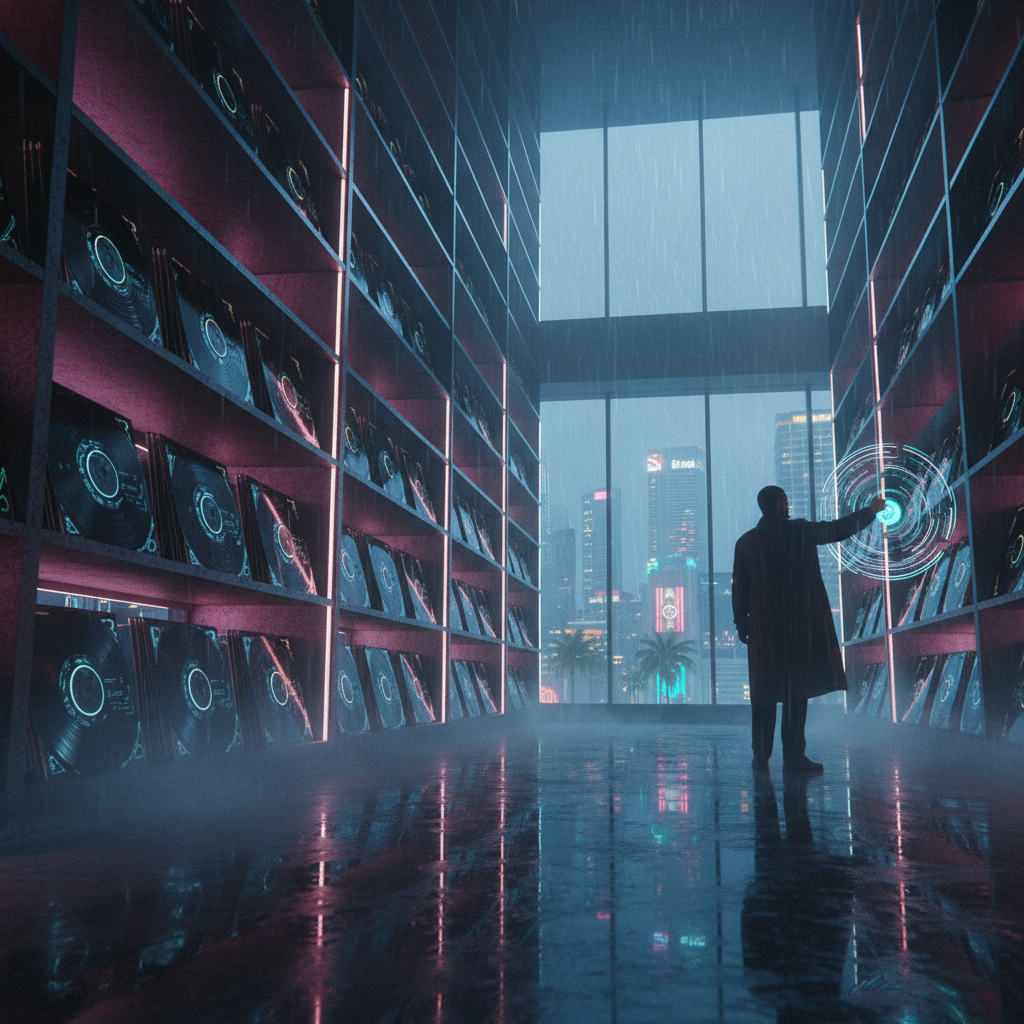
Before Spotify algorithms and streaming libraries, there was a man in a basement, flipping through hundreds of records in the dark, searching for the one break that nobody else had found. That man was a DJ. And in that obsessive, almost sacred act of crate digging, he was doing something far more important than building a setlist — he was preserving music history.
The journey from vinyl crates to USB drives is one of the most fascinating technological evolutions in modern music culture. But it's also a story about something deeper: the DJ as archivist, curator, and cultural historian. In Miami — a city where house, techno, Latin, and hip-hop collide in real time — that responsibility carries extra weight.
The Crate as Cultural Archive
The crate digger was the original music historian. Long before digital databases, DJs like DJ Shadow, Larry Levan, and Frankie Knuckles spent years — sometimes decades — building physical libraries of records that documented entire sonic lineages. A single crate might hold forgotten funk 45s from 1973, unreleased boogie pressings from Chicago, or rare Miami Bass cuts that never made it to mainstream distribution.
This wasn't collecting for nostalgia's sake. It was active musicology. DJs understood that if they didn't find and play these records, the music would simply disappear.
"The DJ was the bridge between a forgotten pressing plant and a crowd that had never heard anything like it."
The dancefloor was the only venue these tracks would ever reach a live audience. In South Florida specifically, record shops like Yesterday & Today Records and Uncle Sam's Music became underground institutions. Miami DJs were uniquely positioned at a cultural crossroads — absorbing Caribbean rhythms, Latin percussion, and Northern electronic influences all at once. The crates told that story in real time.
PRO TIP: The Archivist's Ethic True digging is about more than finding "hits." It is about active musicology—finding and playing records that would otherwise disappear from the cultural conversation.
The Digital Shift: Serato, Rekordbox, and the USB Revolution
When Serato Scratch Live launched in 2004, the industry fracture was immediate. Purists called it the death of authenticity. Pragmatists called it liberation. Both were partially right.
What nobody fully anticipated was how digital formats would actually expand the archival capacity of the DJ. A single USB drive loaded via Pioneer's Rekordbox software can now hold more music than a thousand-record crate — complete with waveform analysis, cue points, BPM grids, and metadata tags that function like a personal music encyclopedia. The archive didn't shrink. It exploded.
The Pioneer CDJ-3000, the current industry benchmark, is where this archival philosophy reaches its technological apex. The 9-inch touchscreen and dedicated high-res waveform display allow DJs to navigate massive libraries with the same intuitive speed a veteran digger once used flipping through cardboard dividers.
PRO TIP: Mastering Metadata Digital archives require intentionality. Use Rekordbox to tag not just BPM and key, but energy arc, crowd context, and personal notes to transform a list of files into a navigable history.
The difference is scale. A DJ performing at LIV or Club Space Miami tonight might have 50,000 tracks at their fingertips — a collection that would have required a warehouse of crates a generation ago. But access without understanding is just noise. And that's the nuance that separates serious DJs from those just pointing at a waveform.
What Gets Lost — and What Must Be Carried Forward
Here's the tension that every serious DJ eventually confronts: digital tools make music accessible, but they don't transmit musical knowledge.
"Knowing that a track is 128 BPM is not the same as knowing it was originally cut at 33 RPM and sounds completely different when played at 45."
Knowing a track's key signature in Rekordbox is not the same as training your ear to blend harmonics without a visual cue. The DJs who have navigated this transition most successfully — Four Tet, Nina Kraviz, Jamie Jones, Black Coffee — share a common thread: they came up in an era that demanded active listening, deep cataloguing, and an almost scholarly relationship with music. They brought that ethic into the digital world. Their USBs aren't random playlists. They're curated archives built with the same intentionality as a digger's crate.
This is why dedicated practice time on professional equipment isn't optional for a DJ who wants to perform at this level. Loading tracks into Rekordbox at home is one step. Understanding how those tracks breathe, layer, and transition on a full Pioneer CDJ-3000 and DJM-V10 setup — with real fader response, analog-modeled filters, and professional monitor feedback — is another entirely. Many Miami DJs book regular sessions at Sonic Spectrum precisely for this reason: to rehearse their archives in a real performance environment before stepping behind a club booth.
Building Your Own Archive in the Digital Age
For Miami DJs building a serious library today, the methodology hasn't changed as much as the medium. Start with intention: curate by story, not just genre. Build folders in Rekordbox that reflect musical lineages — trace a groove from James Brown to Chicago house to Miami Bass to Afrohouse.
Use the CDJ-3000's memory cue and loop systems to mark the moments within a track that carry historical weight — the drum break, the sample source, the build that still works forty years later.
PRO TIP: High-Stakes Rehearsal Use professional DJ practice rooms in Miami to test how your digital archive breathes on club-standard gear. Muscle memory on a DJM-V10 is what separates a bedroom hobbyist from a professional headliner.
Practice navigating these libraries under pressure in a professional setting, where the monitor mix and equipment response mirror what you'll actually face on a real stage. The archive is only as good as your ability to deploy it in the moment. That requires muscle memory. And muscle memory requires reps on real gear.
The DJ as Historian, Then and Now
From Larry Levan's Paradise Garage to tonight's headliner at a Wynwood warehouse party, the through-line is unbroken: the DJ is the custodian of a living musical archive. The format changed. The mission didn't.
Miami has always been a city that takes that mission seriously — a melting pot where the archive is always expanding, always absorbing new influences, always being recontextualized on a dancefloor at 2am. The DJs who honor both the crate and the USB, who understand where the music came from before deciding where to take it next, are the ones who build careers that last.
The tools evolved. The craft — and the responsibility to preserve it — never will.
 FOLLOW US